

Book your Brain TheraCamp™ Consultation Call - select one of the options:
Children, Adults and High Achievers (executives, athletes, musicians)
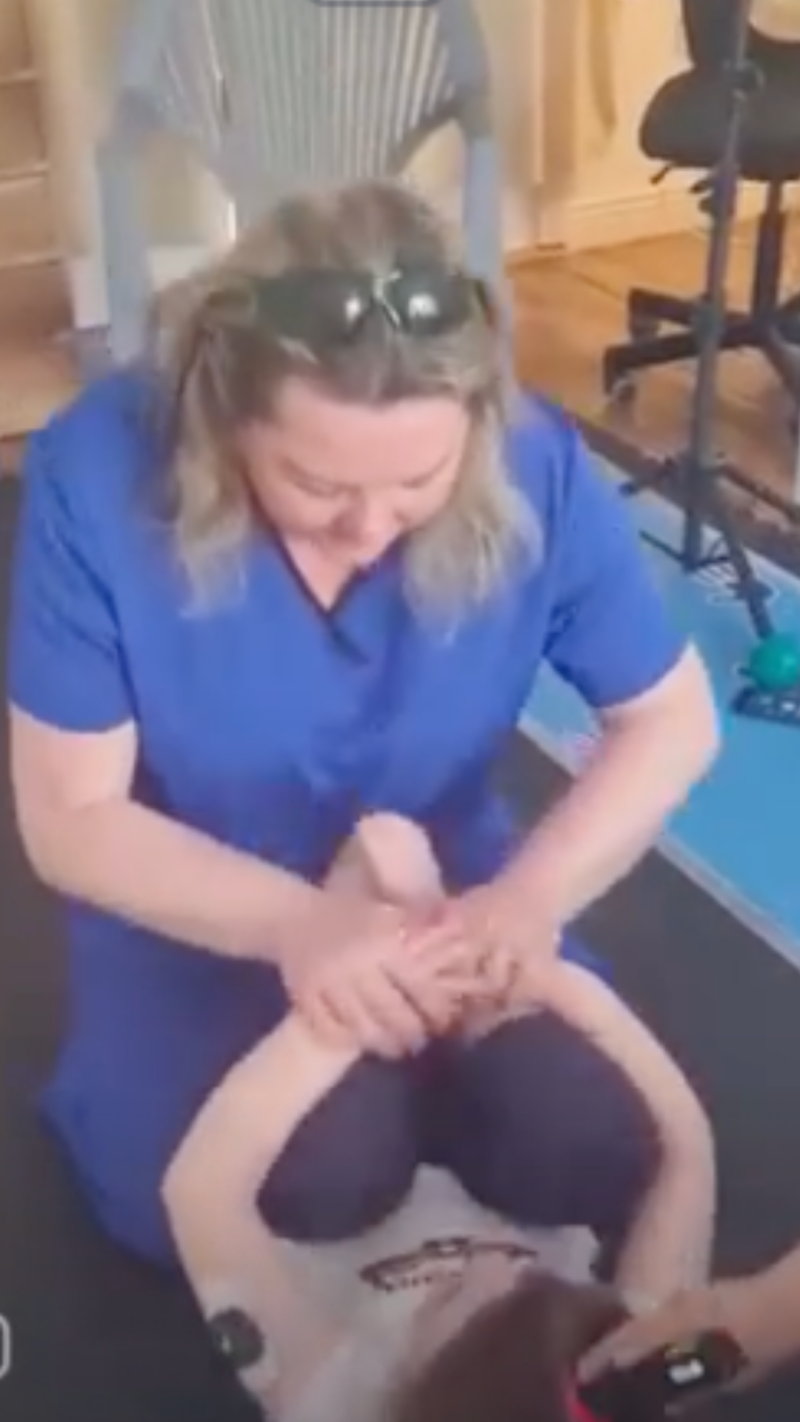
What is our Brain TheraCamp ™ Melillo Intensive
vertical and horizontal integration, primitive reflex therapy, posture, balance, vestibular, eye movements, brainstem integration, cortical connectivity and hemispheric integration
KEY FEATURES OF THE BRAIN THERACAMP:
- Comprehensive functional neurology Melillo Method assessment takes place on day 1 of the Brain TheraCamp
- Brain TheraCamp is aimed at the profound brain stimulation to cause positive neuroplastic functional and structural lasting changes.
- Parents /clients get training during the TheraCamp by our experienced certified Melillo Method TM therapist who is also a certified IM provider, a reflex integration therapist and a childhood neurodevelopmental specialist
- Post - intervention assessment takes place on the last day of the Theracamp
- A home program is provided on the last day of the theracamp with a set of of exercises, along with the educational videos, as the step-by-step protocols that are easy to follow at home
- Two follow up calls in the week 4 and 8 post the theracamp

Interested in a brain-based approach to improve your or your child's functioning, such as autism, ADHD, dyslexia, traumatic brain injury, sensory processing, motor coordination, learning disabilities ?
Our Melillo Method Brain TheraCamps are aimed at clients looking at obtaining functional improvements, thanks to the intensive brain stimulation causing positive changes in a short time.
Review the research studies on the Melillo Method™ and Brain Balance™.
You or your child will work with some, not all, of the cutting-edge NeuroTools used in the area of developmental functional neurology as part of The Melillo Method ™ protocols.
In the intensive programs we re-wire the brain while following specific advanced hemispheric-based protocols and some cutting-edge tools used in the field of developmental functional neurology and functional neurosciences.
'' The goal is simple: restore balance to the brain by targeting specific networks on one side of the brain with very specific stimulation. By combining different types of stimulation (light, sound, smell, movement, inner ear, balance, touch) along with cognitive and academic activities etc., we can activate specific networks on one side of the brain, causing them to grow and become more connected.''
- by Dr. Melillo
WHAT DOES THE BRAIN THERACAMP LOOK LIKE?
The 1-1 intensive Brain TheraCamp program has minimum 10 hours and is individualised for each child or adult to meet their specific needs, but the general procedure is similar.
Assessment on day 1
Each client is first tested using a number of standardised tests to establish if there is an imbalance in the brain, which part of the brain is underdeveloped and which one is overdeveloped, and exactly which parts of the brain are most delayed in their development. To make this assessment, motor and coordination abilities, sensory processing, cognitive and academic skills are measured. Diet and habits that may negatively affect the brain and its development and balance are also assessed.
Intervention
Based on the results of the testing, an individualised programme is developed that addresses the specific needs of the particular client
A multimodal approach is used for maximum effect and supporting the integration of different brain areas, as well as the two hemispheres as a whole. Usually, a child does not need all possible interventions, but a unique combination involving some of them.
There is always a home program that runs post to the intensive Brain TheraCamp sessions.
Parents and adult clients are instructed how to do various exercises and stimulations included in it.
Here are some examples of the multi-modal stimulation during the intensive Brain TheraCamp program with the use of cutting-edge technology
SENSORY STIMULATION
- Light, optokinetic and other types of visual stimulation
- Sound and music therapy
- Smells and aromatherapy
- Tactile stimulation
- Vibration stimulation
- Balance and proprioception exercises
- Vestibular activities with rotation
NUTRITIONAL EDUCATION
- Elimination diets
- Diets to balance the immune system
- Diets to support brain function
DIGITAL HEALTH
- Digital programs for video games, virtual reality and programs with music, sounds, vibrational frequencies and laser
MOTOR ACTIVITIES - Exercises to integrate primary reflexes
- Developmental exercises
- Exercises for strength and stability of the core and lateral muscles
- Exercises to balance muscle tone
- Exercises to develop the dominant side
- Interactive metronome
- Eye exercises
- Exercises for fine motor skills
BEHAVIORAL AND SOCIAL THERAPIES
- Mirror therapy
- Behavioural modifications
COGNITIVE AND LEARNING ACTIVITIES TO DEVELOP:
- Reading
- Reading comprehension
- Listening comprehension
- Spelling
- Mathematics
- Organisational skills
- Goal setting skills
- Caution
- Concentration
- Memory
- Executive functioning skills
- Phonological awareness and word decoding
We are focused on addressing the primary issue in most learning disabilities and behavioural disorders which is known as a functional disconnection.
Functional disconnection has become one of the leading theories in the world related to Autism, ADHD, Dyslexia and more. Dr. Melillo's - my mentor's work is leading the way toward understanding the underlying nature of these disorders and their causes.
Functional Disconnection — The Leading Theory
We focus on solving the core problem underlying most learning and behavioural disorders — Functional Disconnection Syndrome.
Functional Disconnection is one of the world's leading theories, developed by Dr. Robert Melillo — my mentor — pioneering in understanding the nature of neurodevelopmental disorders and their causes.
The Functional Disconnection theory proposes that at the root of most neurodevelopmental disorders — ADHD, autism, dyslexia, OCD — lies a lack of synchronisation between the two brain hemispheres, rather than damage to a specific brain area.
Mechanism
In the 1990s, Dr. Melillo discovered that in children with learning and behavioural difficulties, one brain hemisphere matures faster than the other. Over time, the more developed side begins to compensate and dominate, while the weaker side falls further behind — creating what is known as developmental asynchrony. The hemispheres stop synchronising electrically, making it impossible for them to share and integrate information — the brain no longer functions as a whole.
How It Presents
A child with Functional Disconnection simultaneously has:
-
Remarkably strong skills associated with the more developed hemisphere (e.g. fluent reading, rich vocabulary, analytical abilities)
-
Notably weak skills associated with the underdeveloped hemisphere (e.g. motor coordination, emotional regulation, sensory processing, social skills)
This explains why children can perform somersaults on gymnastic rings but cannot ride a bicycle — or read fluently while their drawings and articulation are significantly below age level.
It is not a lack of intelligence or motivation — it is a lack of connection between the hemispheres.
Which Hemisphere — Which Symptoms
-
Weak right hemisphere — typical for ADHD and autism — difficulties with emotional regulation, attention, motor coordination, sensory processing, and social skills, alongside strong verbal and analytical abilities.
-
Weak left hemisphere — typical for dyslexia — difficulties with reading, writing, and speech, alongside strong spatial and creative abilities.
-
Obsessive, compulsive, or hyperreactive behaviours may indicate a left hemisphere that is "too strong" relative to the right.
Why It Matters
The most important conclusion from this theory: Functional Disconnection is reversible. By stimulating and strengthening the weaker hemisphere, brain balance can be restored — and symptoms, even diagnoses, can resolve.
This is the foundation of the entire Melillo Method™ and the Brain TheraCamp™ approach — we do not work with symptoms, but with the cause: the lack of hemispheric synchronisation.
Scientific Evidence
The Functional Disconnection theory was first described in 1972 by Dr. Gerrald Leisman and subsequently developed by Dr. Melillo as the primary mechanism underlying ASD and other disorders. Research published in peer-reviewed scientific journals confirms that reduced activity and coherence in the right hemisphere explains autism spectrum symptoms as well as increased sympathetic activation.
Currently we are taking bookings for March - May per our schedule
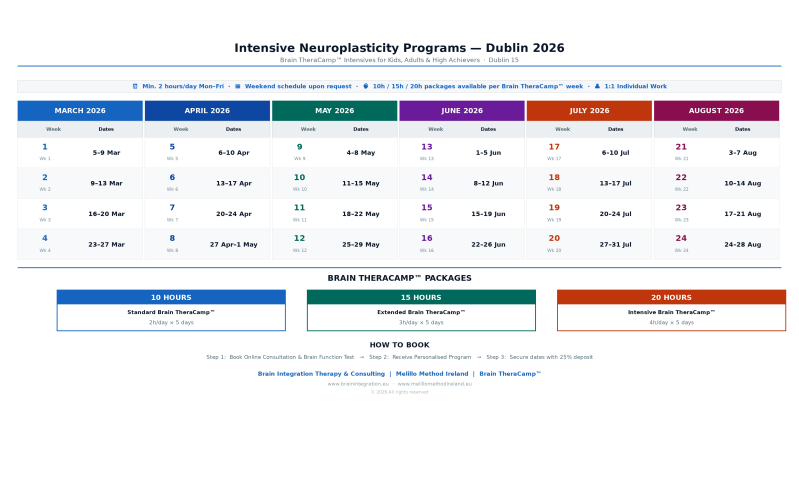

Need a weekend schedule? If weekday sessions don't work for you, please email us. Weekend availability may be arranged upon request, subject to availability and an additional fee.
How to Sign Up for Brain TheraCamp™ in Dublin
To sign up for Brain TheraCamp™ and learn more about the programme, an initial online consultation with a Brain Test is required.
What Does the Initial Consultation Include?
-
Completing the Brain Test prior to the consultation
-
A detailed interview with the client or the child's parent
-
An opportunity to ask questions about the programme, the camp schedule, and expected outcomes
-
A review of the Brain Test results
What Happens After the Consultation?
Based on the Brain Test results and the interview, we present a personalised offer — a Brain TheraCamp™ Melillo Intensive in Dublin, or Katowice, or a home-based programme, depending on the client's profile and needs.
We are unable to provide an offer without reviewing the Brain Test results — every programme is individually tailored to the client's neurodevelopmental profile.
Start with an Online Consultation & Hemispheric Brain Function Test to qualify for a Brain TheraCamp™ or Virtual Program.